Applied Photovoltaic Research at EU PVSEC 2026
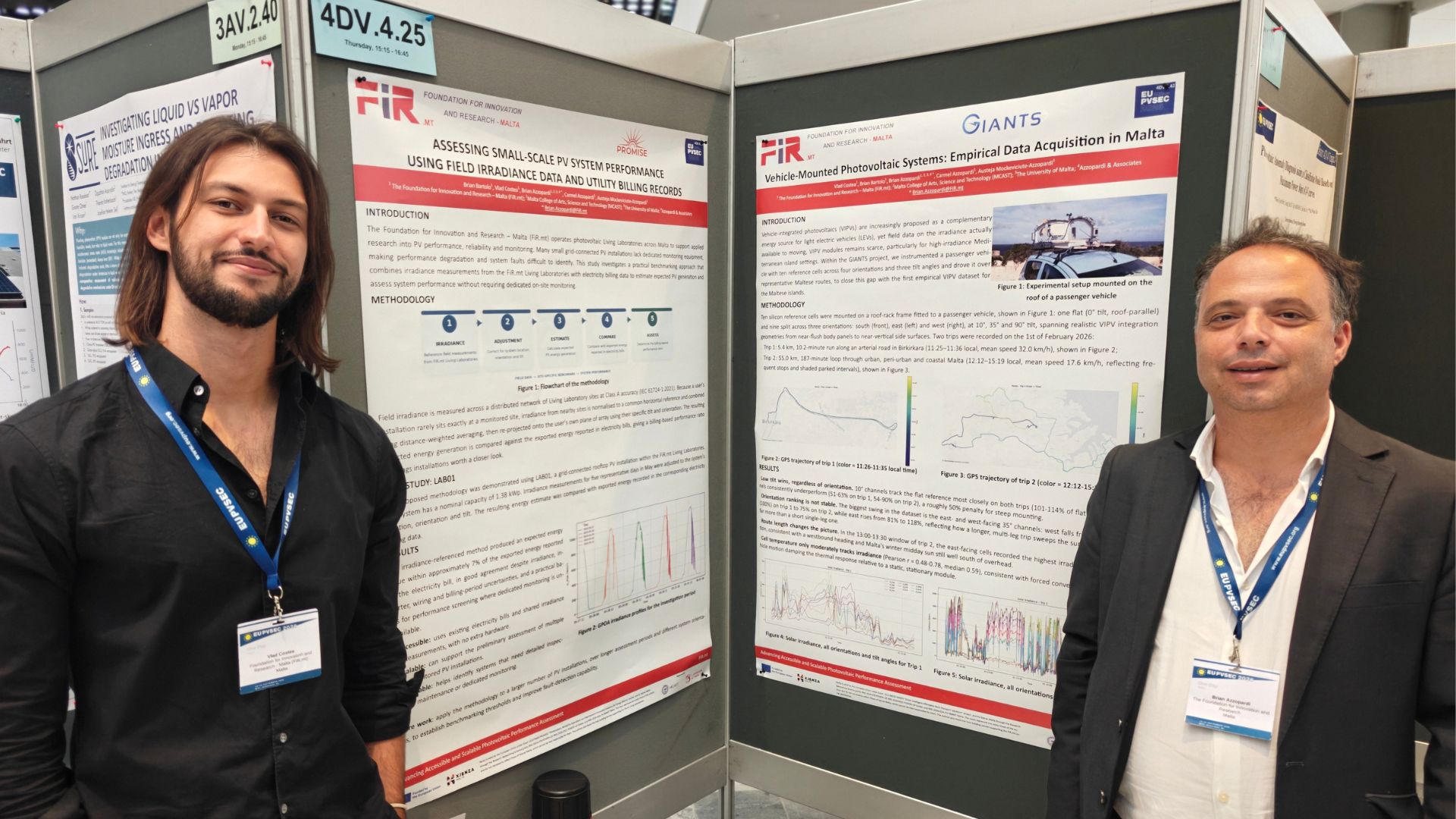
The Foundation for Innovation and Research – Malta (FiR.mt) presented two research contributions this week at EU PVSEC 2026, highlighting ongoing work in photovoltaic performance, reliability, Living Laboratories and emerging applications of solar energy in electric mobility.
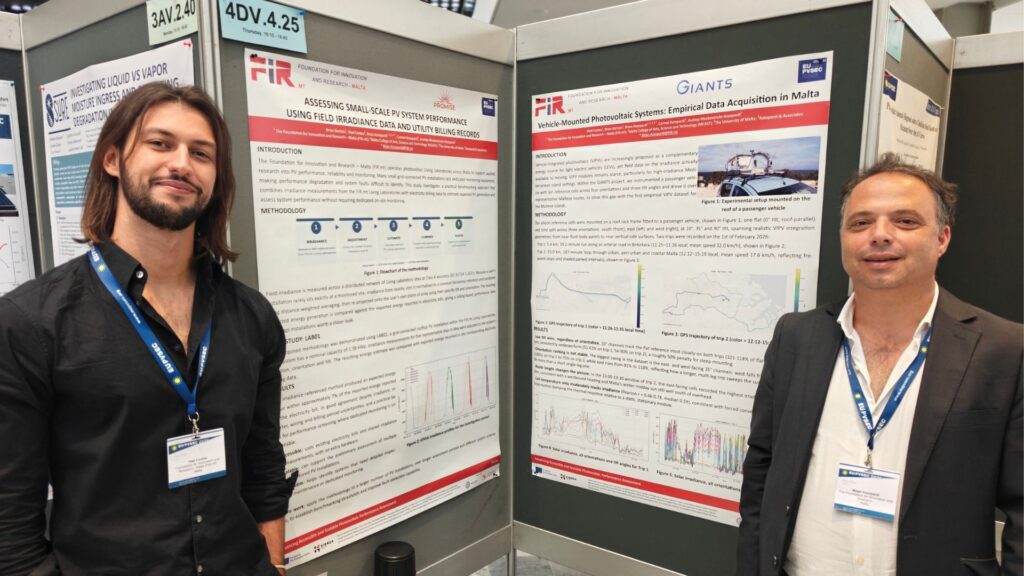
Brian Azzopardi and Vlad Costea presented two posters and accompanying papers presented research developed through FiR.mt and its collaborative research activities.
Using Malta’s Living Laboratories to Assess PV Performance
The paper, “Assessing Small-Scale Photovoltaic System Performance Using Field Irradiance Data and Utility Billing Records,” by Brian Bartolo, Brian Azzopardi, Carmel Azzopardi and Austeja Mockeviciute-Azzopardi, addresses a practical challenge affecting many residential and small-scale PV installations: how can their performance be checked when dedicated monitoring equipment is not available?
The research combines field irradiance measurements from the Malta PV Living Laboratories with readily available electricity billing records. Measurements from different Living Laboratory sites are spatially weighted and adapted to the orientation and inclination of the individual PV installation, providing an expected energy yield against which actual exported energy can be compared.
Applied to a 1.38 kW reference installation, the approach estimated PV generation to within approximately 7% of the utility metered energy, demonstrating the potential for a practical, low-cost first-level health check for PV systems without dedicated monitoring. Future work envisages extending the methodology across more installations and developing a bespoke application through which users could benchmark their own residential PV systems.
Taking Photovoltaics onto the Road
The paper, “Vehicle-Mounted Photovoltaic Systems: Empirical Data Acquisition in Malta,” by Vlad Costea, Brian Bartolo, Carmel Azzopardi, Austeja Mockeviciute-Azzopardi and Brian Azzopardi, moves photovoltaics from buildings to mobility.
The work reports the first empirical vehicle-integrated photovoltaic irradiance dataset for the Maltese islands. Ten solar reference cells, representing different orientations and tilt angles, were mounted on a passenger vehicle and tested over two trips covering approximately 60 km of Maltese roads, while irradiance, temperature, wind conditions and GPS position were recorded.
The results demonstrate why vehicle-integrated PV cannot simply be treated like a static rooftop system. Low-tilt configurations consistently performed better than steep 90° mounting, while the best-performing orientation changed with the vehicle’s route, heading and time of day. The findings therefore support the development of route- and time-aware models for vehicle-integrated photovoltaics, rather than relying on a fixed assumption about the optimum orientation.
This research contributes directly to the GIANTS – Green Intelligent Affordable New Transport Solutions project and its development of frugal, zero-emission light electric vehicle concepts.
From Rooftops to Mobility
Together, the two contributions illustrate the breadth of FiR.mt’s applied photovoltaic research: using real-world measurements to better understand the performance of PV systems already installed on our rooftops, while exploring how solar energy can become more effectively integrated into future mobility.
Both studies are grounded in experimental data collected in Malta and demonstrate the value of developing Living Laboratories and field-based research infrastructure that can support solutions relevant locally while contributing evidence to wider European research.
The work on PV performance was partly funded by the European Union through PROMISE (Grant 101079469) and by Xjenza Malta through POWER-UP, POWER-UP Global and PV-SMART Malta. The vehicle-mounted PV research was funded by the European Union through GIANTS (Grant Agreement 101138220) and partly by Xjenza Malta through the same Research Networking Scheme initiatives.
FiR.mt’s participation at EU PVSEC 2026 continues its engagement with the international photovoltaic research community, connecting research infrastructure in Malta, experimental evidence and emerging applications across the energy and mobility transition.