Advancing PV–EV Integration Research at EuroSun 2026
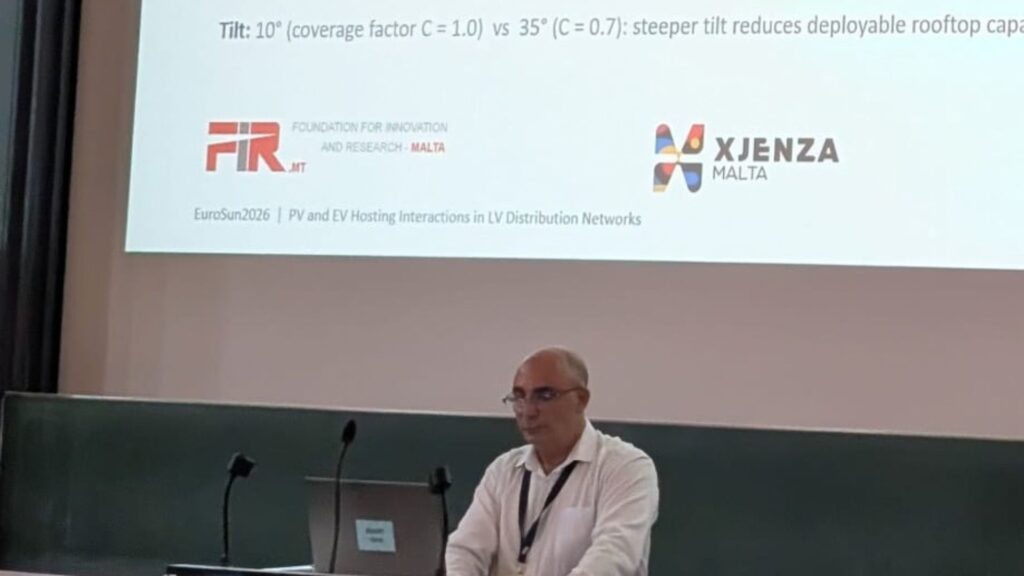
Brian Bartolo, Postgraduate Researcher at the Foundation for Innovation and Research – Malta (FiR.mt), presented new research at EuroSun 2026, contributing to the international discussion on how growing levels of rooftop photovoltaics (PV) and electric mobility can be accommodated within future low-voltage electricity networks.
The paper, “PV and EV Hosting Interactions in Low-Voltage Distribution Networks: Effects of Photovoltaic Orientation and Tilt,” is authored by Vlad Costea, Brian Bartolo and Brian Azzopardi, with Brian Bartolo serving as the presenting author.
The research addresses an increasingly important question for the energy transition: can the way rooftop PV systems are physically planned and deployed help electricity networks accommodate increasing levels of both solar generation and electric vehicles?
Rather than considering every rooftop PV installation in isolation and simply maximising its individual annual energy yield, the study examines PV deployment from a wider street and distribution-network perspective. In urban areas, the orientation of streets and buildings naturally creates opportunities for south-, east- and west-facing PV installations. Strategically using this diversity can spread solar generation across a wider part of the day rather than concentrating generation around the same midday peak. The study specifically compares uniform south-facing deployment with a mixed configuration of approximately 50% south-, 25% east- and 25% west-facing systems.
Using a Monte Carlo time-series simulation framework representative of a Maltese urban low-voltage network, the research examines different levels of PV and EV penetration together with different PV orientations and tilt configurations. The analysis combines residential demand and EV charging profiles with PV generation derived from locally measured irradiance and module-temperature data from the Malta PV Living Laboratories.
The findings show that the interaction changes as PV and EV penetration increases. At high PV penetration, concentrated solar generation can create reverse power flows and overvoltage. As EV penetration increases, some charging naturally coincides with PV generation and can partially absorb locally generated electricity. At still higher EV penetration, however, charging demand becomes dominant, increasing feeder loading and eventually creating undervoltage constraints.
Importantly, the results highlight the potential value of planning PV deployment at street and neighbourhood level as a passive network-integration measure. Appropriate consideration of building orientation, PV orientation, inclination and available rooftop area can influence both the magnitude and timing of solar generation. Mixed east-, south- and west-facing deployment can redistribute generation throughout the day, while different tilt configurations introduce a trade-off between rooftop utilisation, installed PV capacity and network impact.
This means that part of the challenge of accommodating increasing PV and EV penetration could be addressed at the planning and installation stage, without initially relying on active or “smart” interaction between the technologies. Rather than treating PV systems as independent rooftop installations, coordinated planning that considers the orientation of streets, buildings and the characteristics of the local distribution network could help make better use of Malta’s constrained urban rooftop resource while reducing PV-driven network stress.
The research also shows the limits of passive measures. Uncontrolled EV charging does not consistently coincide with peak solar generation and therefore cannot be relied upon to resolve PV-driven overvoltage. Likewise, once EV penetration becomes sufficiently high, changing PV orientation or the investigated tilt/coverage configuration provides relatively little mitigation of EV-driven undervoltage. Smart or PV-responsive EV charging may therefore become a subsequent complementary step, using the flexibility of EV demand to better align charging with periods of local renewable generation and avoid new charging-related peaks.
The work builds upon the FiR.mt Living Laboratories in Malta, which provide locally measured data and experimental infrastructure supporting research into PV performance, reliability and grid integration.
The research was partly funded by the European Union through the PROMISE – Photovoltaics Reliability Operations and Maintenance Innovative Solutions for Energy Alliance project (Grant 101079469) and the GIANTS – Green Intelligent Affordable New Transport Solutions project (Grant 101138220). It was also supported by Xjenza Malta Research Networking Schemes 2024 and 2026 through POWER-UP (RNS-2024-078), POWER-UP Global (RNS-2026-0321) and PV-SMART Malta (RNS-2026-024L). The authors also acknowledge the owners of the PV test sites deployed as part of the FiR.mt Living Laboratories in Malta.
The presentation reflects FiR.mt’s continued commitment to connecting experimental research, advanced modelling and practical energy-system planning. The work points towards a layered approach to the energy transition: first designing and deploying distributed energy resources more intelligently within the physical urban environment, and subsequently complementing these passive measures with active coordination as PV and EV penetration continues to grow.