FiR.mt Presents Vision for EV Infrastructures in Niš, Serbia
The Foundation for Innovation and Research – Malta (FiR.mt) contributed to the international discussion on the future of electric mobility and intelligent energy systems through an invited talk delivered at the IEEE 61st International Scientific Conference on Information, Communication and Energy Systems and Technologies, IEEE ICEST 2026, in Niš, Serbia.
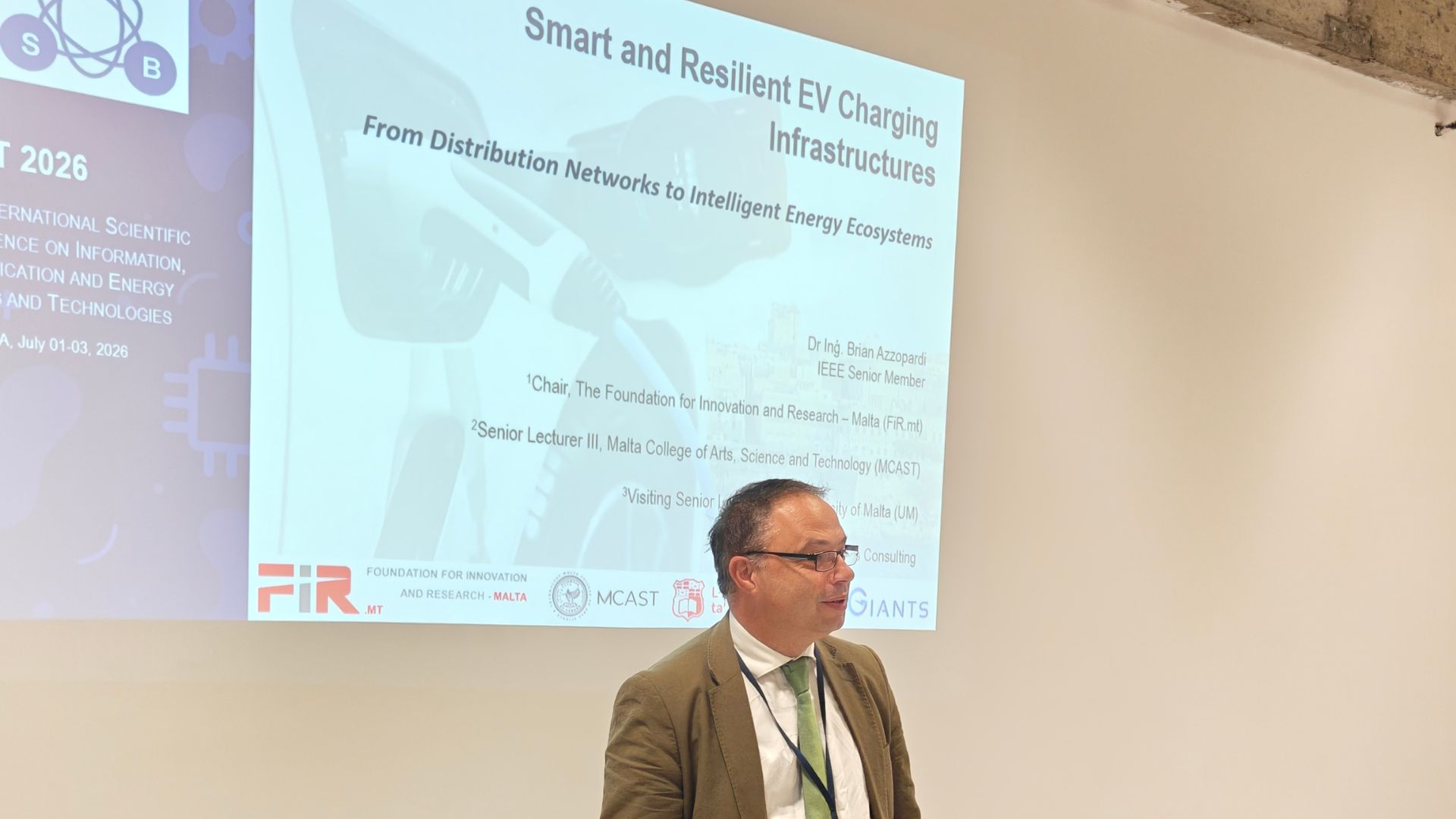
Dr Inġ. Brian Azzopardi, Chair of FiR.mt and Senior Lecturer III at the Malta College of Arts, Science and Technology (MCAST), delivered the invited presentation “Smart and Resilient EV Charging Infrastructures: From Distribution Networks to Intelligent Energy Ecosystems”. The presentation addressed a fundamental shift taking place within electric mobility: EV charging infrastructure is evolving from a passive electrical load into an active and intelligent component of future energy systems.
“The future of EV charging is no longer about chargers; it is about intelligent energy ecosystems.”
Drawing upon research undertaken in Malta and through European research collaborations, Dr Inġ. Azzopardi outlined how electric vehicles, renewable generation, energy storage, buildings and electricity networks are becoming increasingly interconnected. This convergence is transforming the engineering requirements of charging infrastructure and creating a growing need for systems that are intelligent, interoperable and resilient under real operating conditions.
From Real-World Mobility to Electricity Network Impacts
A central theme of the invited talk was the importance of moving beyond standardised assumptions when planning future charging infrastructure. Research presented during the talk demonstrated how local driving behaviour, including congestion, stop-and-go traffic, road topology and daily trip patterns, can influence vehicle energy consumption and battery utilisation. Representative GPS-based driving data from Malta have therefore been used to develop local driving cycles and complete trip chains for modelling electric vehicle energy requirements. These mobility patterns provide an important link between transport and power-system research. Vehicle energy consumption determines charging demand; charging demand influences electricity-network loading; and network loading ultimately affects how charging infrastructure must be planned and operated. As highlighted during the presentation:
“We are not simply modelling vehicles; we are modelling future electricity demand.”
The presentation also discussed research indicating the potential relevance of smaller, frugal electric vehicles for dense urban environments. Representative Maltese driving patterns suggest that comparatively modest battery capacities may support several days of typical local mobility, strengthening the case for mobility solutions designed around actual user requirements rather than vehicle oversizing.
Understanding EV Hosting Capacity Under Uncertainty
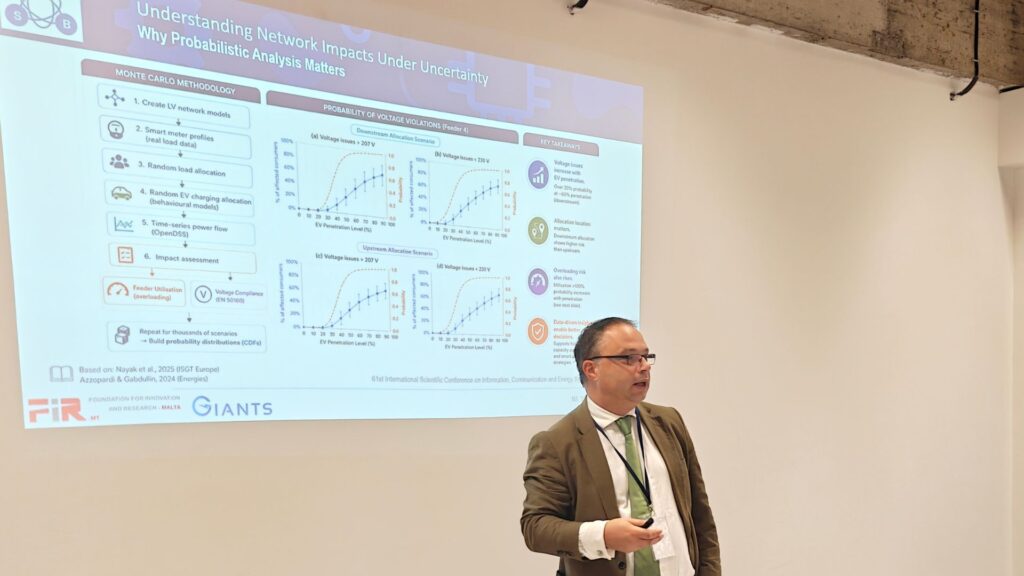
The invited talk further examined the impact of large-scale EV adoption on low-voltage distribution networks. Unlike many conventional electrical loads, EV charging is strongly influenced by human behaviour. Vehicle arrival times, travelled distances, remaining battery state of charge, parking duration and charging location all introduce uncertainty. Increasing levels of rooftop photovoltaic generation and distributed battery storage add further variability to electricity-network operation. FiR.mt’s research therefore applies probabilistic and Monte Carlo-based approaches to investigate thousands of potential operating scenarios rather than relying solely on a single deterministic case.
The analysis presented at ICEST 2026 demonstrated how increasing EV penetration can raise the probability of voltage violations and network overloading, while also showing that the location of charging demand within a distribution feeder can significantly influence network risk. This leads to an increasingly important question for distribution system operators: how many electric vehicles can an existing electricity network support?
The concept of EV hosting capacity was discussed as a key planning metric. Importantly, the talk highlighted that hosting capacity is no longer determined only by transformers and cables. Intelligent coordination of charging can enable existing electricity infrastructure to accommodate greater levels of electric mobility.
“The transformer is the same; the intelligence is different.”
Increasing Network Capacity Through Intelligence
The presentation compared uncontrolled, managed and smart EV charging. Under uncontrolled charging, vehicles may begin charging immediately following arrival, potentially creating concentrated evening demand peaks. Managed charging can shift electricity demand away from existing peak periods. Smart charging extends this further by continuously considering network constraints, renewable generation, energy storage, electricity prices and user requirements. The total energy required by vehicles may remain broadly unchanged. However, when and where that energy is consumed can determine whether EV charging becomes a source of network congestion or a source of energy-system flexibility. The talk consequently positioned future electric vehicles not only as electricity consumers, but as increasingly flexible energy resources capable of supporting renewable-energy integration and future electricity-network operation.
Digital Twins and Hardware-in-the-Loop Validation
A further focus of the presentation was the role of Digital Twins in future charging ecosystems. By continuously connecting physical assets with digital models and operational data, Digital Twins can support renewable-generation forecasting, charging-demand estimation, optimisation of charging schedules and early identification of abnormal operating conditions.
“Sensors tell us what is happening. Digital Twins tell us what will happen next.”
However, the presentation emphasised that intelligent algorithms must be rigorously validated before deployment on real energy infrastructure. FiR.mt’s research approach combines MATLAB and Simulink-based modelling with real-time Hardware-in-the-Loop validation using Typhoon HIL real-time simulation equipment. Vehicle, charging and electricity-system models can therefore be evaluated under safe and repeatable conditions, including renewable-energy variability, changing charging demand, communication failures and abnormal operating scenarios. Hardware-in-the-Loop validation provides an important bridge between numerical simulation and practical deployment, reducing development risk and strengthening confidence in intelligent energy-management strategies before their implementation within real infrastructure.
FiR.mt acknowledges Typhoon HIL for supporting this research through its real-time simulation platform and equipment, enabling the real-time validation activities presented during the invited talk.
From Laboratories to Living Laboratories
The invited presentation also highlighted FiR.mt’s wider research philosophy of progressing from scientific modelling to validation and real-world demonstration. Through Living Laboratories, sensors, edge devices and digital monitoring platforms can continuously capture operational data from real environments. These data provide the basis for refining models, validating technologies and developing solutions around actual operating conditions.
This research philosophy is increasingly being supported through LivingLabOS™, FiR.mt’s developing digital platform for connecting distributed sensors, edge devices, monitoring systems and intelligent analytical tools. LivingLabOS™ is intended to provide a modular digital backbone through which operational data from different Living Laboratories can be collected, analysed and progressively integrated with Digital Twins and artificial-intelligence-based decision support. As summarised during the invited talk:
“Laboratories validate technology. Living Laboratories validate innovation.”
Supporting the Next Generation of Sustainable Mobility
The research presented at ICEST 2026 also drew upon activities undertaken within the GIANTS Horizon Europe project. GIANTS is developing modular and scalable frugal zero-emission light electric vehicle solutions for urban and suburban mobility. The wider project combines vehicle modularity, interoperability and innovative charging and energy-optimisation approaches. Within this wider research context, FiR.mt’s work contributes to understanding representative mobility behaviour, charging-demand modelling and the relationship between future electric mobility and supporting energy infrastructure. The systems perspective presented at ICEST 2026 demonstrated why transport engineering, power systems, digital technologies and user behaviour must increasingly be considered together when developing future mobility solutions.
Towards Autonomous Energy Ecosystems
Looking ahead, the invited talk identified a progression from smart charging towards increasingly autonomous energy management. Artificial intelligence, Digital Twins and edge computing are expected to support predictive optimisation and local decision-making, while cybersecurity, interoperability and climate resilience will become increasingly important engineering requirements.
The central message delivered at ICEST 2026 was that the next generation of EV infrastructure will not be defined by a single charging technology. Instead, the future lies in the convergence of electric mobility, renewable energy, energy storage, intelligent buildings, Digital Twins, artificial intelligence and resilient electricity networks.
“The future is not a smarter charging station; it is an autonomous energy ecosystem.”
Participation in ICEST 2026 provided FiR.mt with an opportunity to disseminate Malta-based research, exchange knowledge with the international scientific community and explore future research collaboration in intelligent energy systems and sustainable mobility.
The international engagement was partly supported through the GIANTS Horizon Europe project and by the ICEST 2026 conference organisers. FiR.mt also acknowledges Typhoon HIL for supporting the research and real-time validation activities through its Hardware-in-the-Loop simulation equipment and platform.
Through its research activities, Living Laboratories and international partnerships, FiR.mt continues to strengthen Malta’s contribution to the development of intelligent, resilient and sustainable energy systems.