Advancing PV–EV Integration Research at EuroSun 2026
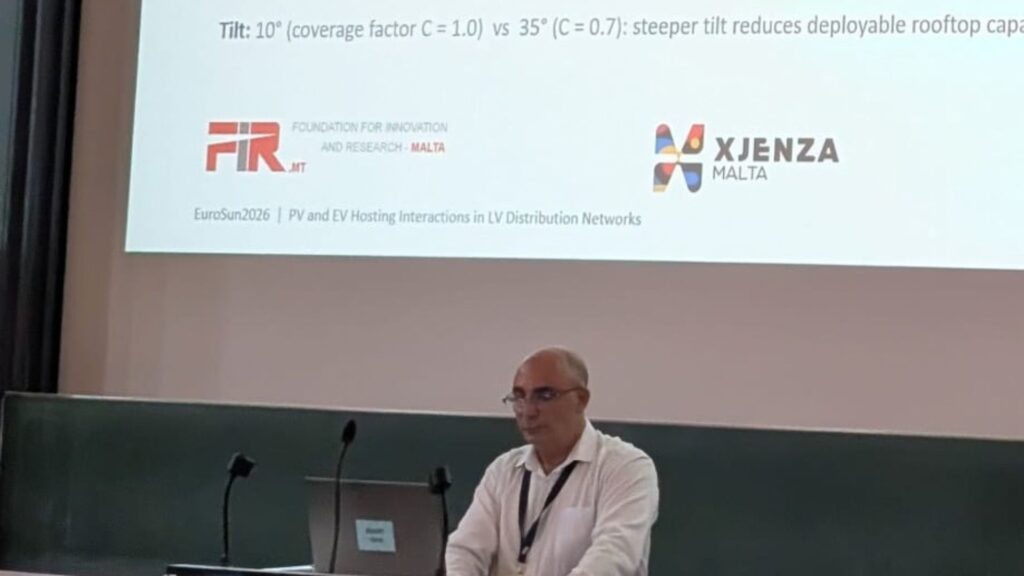
FiR.mt is pleased to share that Brian Bartolo, Postgraduate Researcher at the Foundation for Innovation and Research – Malta (FiR.mt), presented new research yesterday at EuroSun 2026, contributing to the ongoing international discussion on the integration of photovoltaic systems and electric mobility within future low-voltage electricity networks.
The paper, “PV and EV Hosting Interactions in Low-Voltage Distribution Networks: Effects of Photovoltaic Orientation and Tilt,” is authored by Vlad Costea, Brian Bartolo and Brian Azzopardi, with Brian Bartolo serving as the presenting author.
The research investigates an increasingly important challenge for the energy transition: what happens to local electricity networks when high levels of rooftop solar PV and electric vehicle charging are introduced simultaneously?
Using a Monte Carlo time-series simulation framework representative of a Maltese urban low-voltage network, the study examines different levels of PV and EV penetration together with different photovoltaic orientations and tilt configurations. The analysis combines residential demand and EV charging profiles with PV generation derived from locally measured irradiance and module-temperature data.
The findings identify a transition from PV-dominated network conditions, where high solar generation can lead to reverse power flows and overvoltage, through an intermediate PV–EV balancing region, towards EV-dominated conditions, where increasing charging demand can result in high feeder loading and ultimately undervoltage. Importantly, uncontrolled EV charging does not consistently coincide with periods of peak PV generation and therefore provides only limited mitigation of PV-driven overvoltage.
The research highlights that future network planning should consider PV and EV integration together rather than as independent developments. PV orientation, inclination and rooftop utilisation can influence network behaviour, while increasingly flexible EV demand creates opportunities for managed or PV-responsive charging to improve the interaction between renewable generation and electricity demand.
The work also builds upon the FiR.mt Living Laboratories in Malta, which provide locally measured data and experimental infrastructure supporting research into PV performance, reliability and grid integration.
The research was partly funded by the European Union through the PROMISE – Photovoltaics Reliability Operations and Maintenance Innovative Solutions for Energy Alliance project (Grant 101079469) and the GIANTS – Green Intelligent Affordable New Transport Solutions project (Grant 101138220). It was also supported by Xjenza Malta Research Networking Schemes 2024 and 2026 through POWER-UP (RNS-2024-078), POWER-UP Global (RNS-2026-0321) and PV-SMART Malta (RNS-2026-024L). The authors also acknowledge the owners of the PV test sites deployed as part of the FiR.mt Living Laboratories in Malta.
The presentation reflects FiR.mt’s continued commitment to connecting experimental research, advanced modelling and real-world energy-system challenges, supporting evidence-based pathways towards Malta’s and Europe’s clean-energy transition.