
New Publication on RF Energy Harvesting for IoT
The Foundation for Innovation and Research – Malta (FiR.mt) is pleased to highlight a new publication co-authored by Dr Inġ. Brian Azzopardi in IEEE Access, presenting an important advance in radio frequency energy harvesting (RFEH) for next-generation wearable electronics and IoT applications.
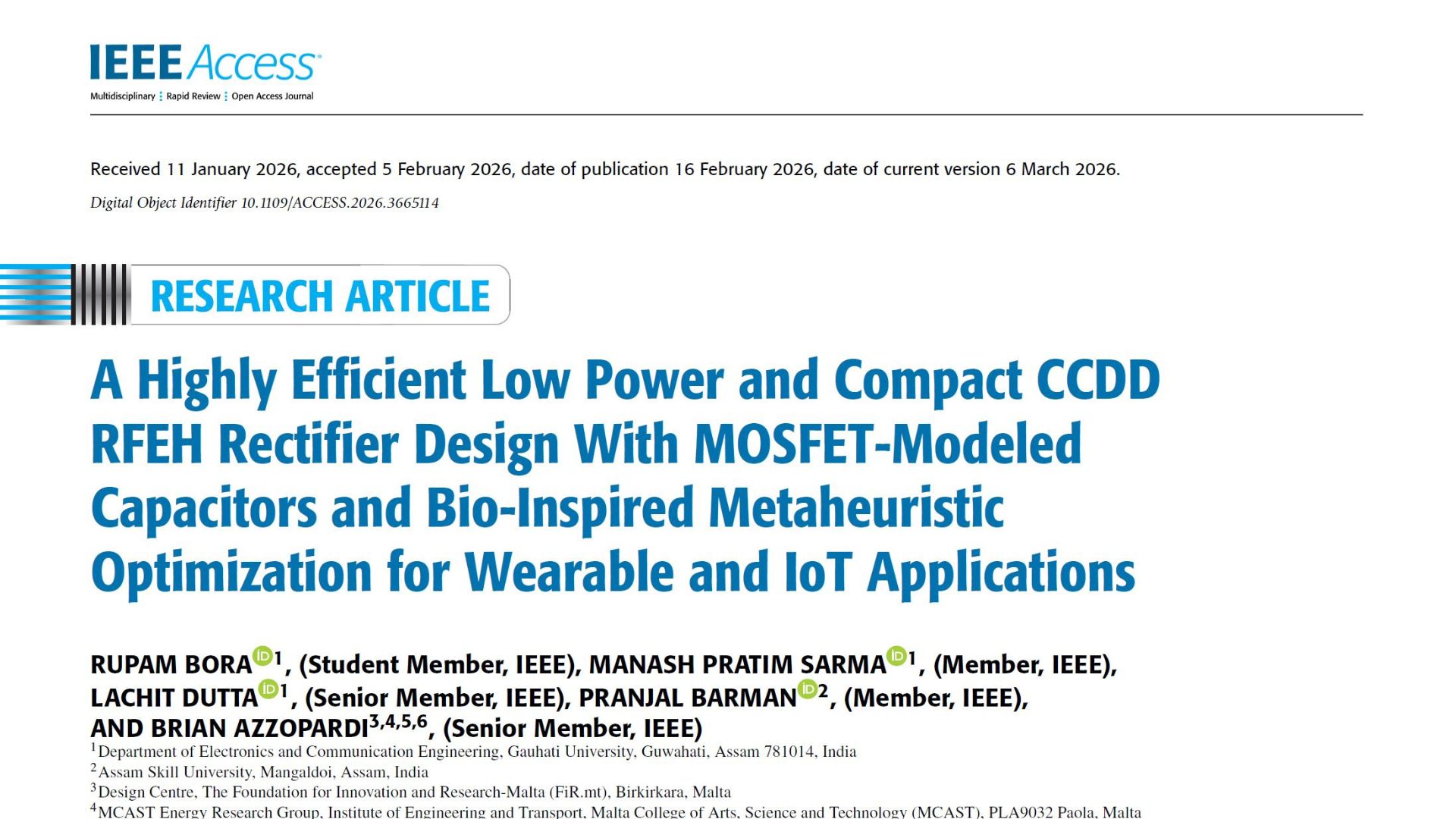
The paper, titled “A Highly Efficient Low Power and Compact CCDD RFEH Rectifier Design With MOSFET-Modeled Capacitors and Bio-Inspired Metaheuristic Optimization for Wearable and IoT Applications,” introduces a novel modified cross-coupled differential-drive rectifier designed to convert weak ambient RF signals into usable DC power more efficiently and with a much smaller circuit footprint.
This is particularly relevant for the future of battery-light or battery-free electronic systems, where the ability to harvest tiny amounts of ambient electromagnetic energy can support autonomous sensors, wearable devices, wireless nodes, and other ultra-low-power systems. As explained in the paper, the rapid growth of IoT and wireless sensor networks is increasing the need for sustainable, maintenance-free power solutions, and RF energy harvesting is emerging as one such pathway.
The core innovation of the work lies in replacing conventional discrete capacitors with MOSFET-modeled capacitors, allowing the rectifier to reduce area consumption while maintaining strong performance. The design is further strengthened through the use of the Walrus Optimization Algorithm (WaOA) to optimize transistor dimensions and improve power conversion across challenging low-input-power conditions.
The results reported in the publication are notable. The proposed rectifier achieves a maximum power conversion efficiency of 93.24% at −17.5 dBm, maintains strong performance at very low input powers, reaches a 25 dB power dynamic range, and occupies an ultra-compact area of 35.22 μm². These characteristics make it especially promising for ambient RF harvesting scenarios in compact low-energy devices.
The publication also reflects the role of TRANSIT – TRANSITion to Sustainable Future through Training and Education as a strong example of how TRANSIT contributes not only to training and education, but to high-quality, internationally visible research outputs.
As part of FiR.mt’s commitment to Open Science and accessible dissemination, this publication is also shared through the wider research visibility ecosystem supported by open repositories such as Zenodo, helping ensure that research outputs remain accessible, citable, and reusable by the international community. In this context, the Foundation’s and related project repositories, including those linked to TRANSIT, continue to play an important role in strengthening long-term visibility and knowledge transfer around published research. Based on the article itself, the main scientific story is the advancement of compact, efficient RF rectifier design for wearable and IoT systems; the repository dimension serves as the infrastructure that helps disseminate and preserve such outputs.
Original Article DOI: 10.1109/ACCESS.2026.3665114
Article in Zenodo Repository https://zenodo.org/records/19164056
TRANSIT Repository on Zenodo https://zenodo.org/communities/transitproject
FiR.mt Repository on Zenodo https://zenodo.org/communities/firmt