
INFRASTRUCTURE
Our Living Labs and Capabilities
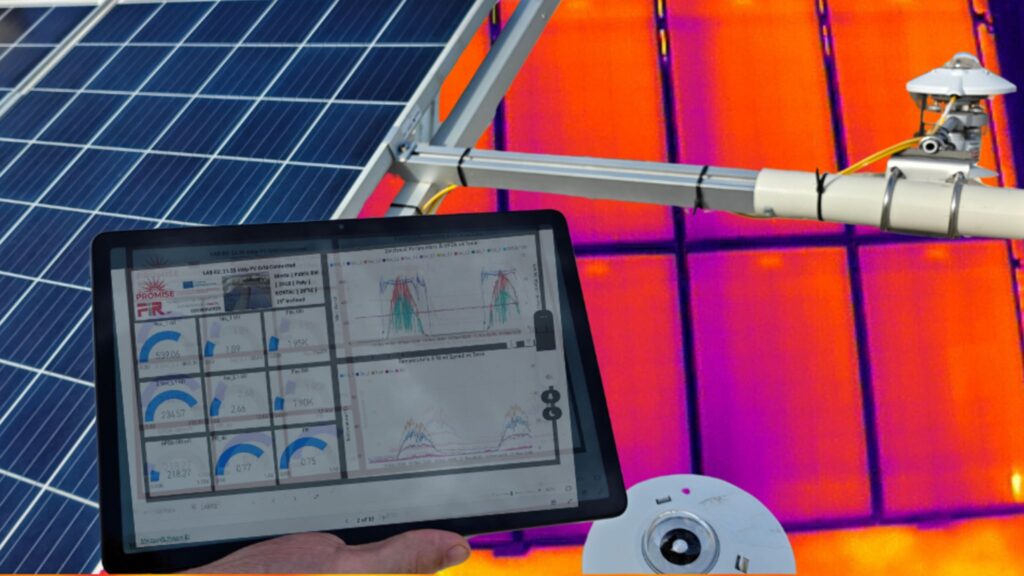
FiR.mt hosts living laboratories and research infrastructure enabling standards-compliant data collection, real-world validation, and hardware-in-the-loop experimentation for energy systems research.
Research Infrastructure for Real-World Validation
FiR.mt develops and hosts open, non-commercial research infrastructure and living laboratories that enable high-quality experimentation, monitoring, and validation of energy technologies under real environmental conditions.
Our infrastructure supports research, policy analysis, education, and innovation activities, with a strong emphasis on data quality, transparency, and reproducibility.
Living Laboratories for Photovoltaics and Energy Systems
Standards-Compliant Data Collection
All monitoring activities are designed in accordance with IEC 61724-1, ensuring:
- correct installation practices,
- traceable measurement accuracy,
- data acquisition framework,
- harmonised performance indicators, and
- high-quality datasets suitable for research, validation, and benchmarking.
Data acquisition framework
- Electrical and environmental data sampled in real-time
- Averaged and recorded
- Designed for long-term reliability, degradation studies, and comparative analysis
PV Module and Inverter Test Infrastructure
Our living lab currently supports:
- Up to 24 photovoltaic modules, each connected individually
- Three microinverters
- Maximum input voltage: 65 Vdc
- Start-up voltage: 22 Vdc
- Two modules reserved for long-term degradation studies
The system is expandable, allowing additional modules, sensors, and configurations to be integrated as research needs evolve.
Cell-Level IV Tracing Capability
For detailed device-level characterisation, we operate:
- 8 independent channels IV Tracer
- Bias range per channel: –7 V to +22 V
- Maximum sink current: 3 A per channel
- Total dissipated power: approximately 100 W
- Automatic thermal protection for safe operation
This setup enables IV tracing and characterisation of photovoltaic cells, including emerging and experimental technologies.
Environmental and Meteorological Measurement Network
To ensure accurate performance assessment and modelling, FiR.mt maintains a distributed environmental monitoring network, including:
Weather Stations
- Integrated environmental monitoring unit for continuous outdoor data collection
- Ambient temperature, wind speed, and wind direction
- Standard ambient temperature, wind speed and irradiance GPOA Installed across 10 different sites
Irradiance and Reference Measurements
- Pyranometers for:
- Global Horizontal Irradiance (GHI)
- Global Plane of Array (GPOA)
- Albedo measurements
- Multiple reference cells for cross-validation and redundancy
Provision exists to extend measurements to direct and diffuse irradiance, further enhancing modelling and performance analysis capabilities.
Multi-Tilt and Multi-Orientation Platforms
FiR.mt operates a multi-tilt and orientation research platform, enabling systematic studies of:
- Tilt angles: 0°, 10°, 35°53′, and 90°
- Orientations: South, East, and West
- 10 reference cells operating simultaneously
This infrastructure supports research on:
- building-integrated photovoltaics (BIPV),
- urban and constrained installations,
- orientation-dependent performance,
- climate-specific optimisation strategies.
Hardware-in-the-Loop and Digital Energy Systems
Typhoon HIL Platform (Incoming)
FiR.mt is expanding its infrastructure with a Typhoon Hardware-in-the-Loop (HIL) platform, enabling:
- programmable IV characteristics and MPPT algorithms,
- real-time testing of power electronics and control strategies,
- validation of inverter behaviour under realistic grid and environmental conditions,
- development of digital twins and advanced control concepts.
This platform strengthens FiR.mt’s capacity in:
- power electronics research,
- grid-connected systems,
- control validation,
- education and advanced training.
Research Use, Openness, and Exploitation
FiR.mt’s infrastructure is operated strictly for research, education, and policy-support purposes, with no commercial exploitation.
It contributes to:
- European and national research projects,
- Living Labs and demonstration activities,
- Key Exploitable Results (KERs) related to monitoring, reliability, digitalisation, and performance assessment,
- open datasets, methodologies, and best-practice guidelines.
A Platform for Collaboration
Our infrastructure is designed to support collaboration across:
- research institutes and universities,
- policymakers and regulators,
- technology developers,
- Social Sciences and Humanities researchers,
- education and training initiatives.
FiR.mt’s infrastructure enables evidence-based research and policy analysis by connecting real-world measurements, digital tools, and societal needs.